A client calls because the website looks dated. Or the deck does not land. Or the sales team keeps losing to a competitor that is demonstrably worse. The brief arrives as a design problem, with a design budget attached.
It usually is not one. Underneath most requests for a refresh sits something quieter and more expensive: the people running the business no longer agree on what it is.
The test
Ask six senior people, separately and in writing, to finish one sentence in under twenty words: we help a particular kind of customer achieve a particular outcome, by doing a particular thing.
Do not warn them. Do not let them confer. Give them ten minutes.
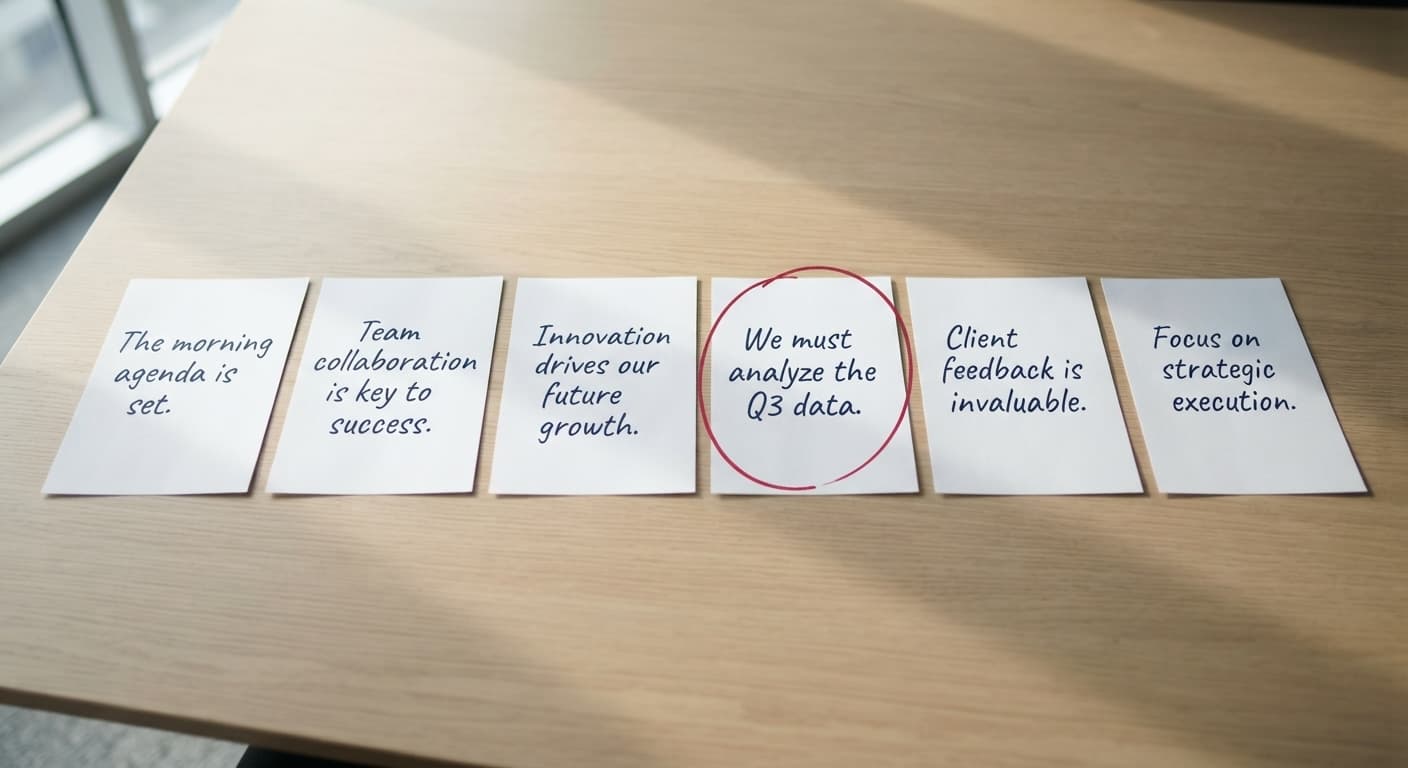
Then put the six answers side by side on one page.
In a business with a clear position, the six answers are recognisably the same sentence. In a business without one, they are six different companies.
We have run this in boardrooms where the chief executive and the commercial director described businesses in different industries. Nobody was wrong. Nobody had noticed.
Why it matters more than it sounds
A brand is not what the leadership team believes. It is the average of what every employee says when nobody senior is listening: to a customer, a candidate, a supplier, a friend at a wedding.
If the six answers diverge at the top, they will diverge everywhere else, amplified. The salesperson improvises. The recruiter oversells. The agency guesses. Every one of those people is filling a vacuum that should have been filled by a decision.
- Marketing spend buys attention for a message that changes between channels.
- Sales cycles lengthen, because the prospect has to do the positioning work themselves.
- Good hires arrive expecting one company and find another.
- Every new asset needs a fresh argument, because there is no agreed standard to measure it against.
What to do with the answers
Resist the urge to merge them. A sentence assembled by committee from six drafts will satisfy everyone in the room and mean nothing outside it.
The useful move is to find where the six genuinely disagree, and treat each disagreement as a decision the business has been avoiding. Who is the customer we are actually for? What are we willing to be worse at? Which of these two futures are we funding?
Those are not brand questions. They are business questions that have been quietly outsourced to the brand, which is why the brand keeps failing to answer them.
The order matters
Design applied to an unresolved strategy is an expensive way to stay confusing. It can make an unclear business look more confident about being unclear, which is worse than looking dated.
Run the test first. It costs an afternoon. If the six sentences match, you probably do have a design problem, and you can proceed with confidence. If they do not, you have found the real brief, and it is a better one.